A home win has a model probability of 50%. Both teams scoring has a probability of 60%. A slip that needs both will win 30% of the time only if the model treats the two outcomes as independent. On a single match, both selections are settled from the same score. Before using the product, ask how often the home team wins specifically among the matches where both sides score.
Account for the scores in four groups
Consider an invented set of 100 equally weighted match outcomes. This set illustrates a probability model. It is not a match sample, an operator quote or a record of results. Let A mean a home win at the chosen settlement time and B mean at least one goal by each team over that same period. A score of 2–1 meets both conditions. A score of 1–0 meets A alone. A score of 1–1 meets B alone. A score of 0–0 meets neither.
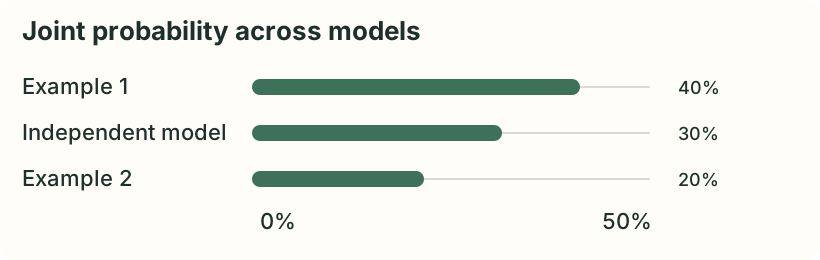
Place 40 of the 100 outcomes in the first group, 10 in the second, 20 in the third and 30 in the last. The home team wins in 50 outcomes and both teams score in 60. The combination is present in 40, because only the first group satisfies both clauses. Each outcome belongs to exactly one group. This is the simplest way I know to catch double counting before getting attached to a combined price.
| Condition | Example 1 | Example 2 |
|---|---|---|
| Both | 40 | 20 |
| Home win only | 10 | 30 |
| Both score only | 20 | 40 |
| Neither | 30 | 10 |
The probability of both selections winning is the chance of A multiplied by the chance of B given A. Among the 50 home wins, 40 have goals from both sides. Thus P(B given A) is 0.80. Multiplying 0.50 by 0.80 gives 0.40. The shortcut of multiplying 0.50 by 0.60 replaced the conditional proportion with the overall proportion. That swap accounts for the entire gap between 30% and 40%.
The two individual probabilities leave room for several answers
Hold the two marginal probabilities at 50% and 60%. You can put 20 results in the joint cell, 30 in A alone, 40 in B alone and 10 in neither. The same two individual probabilities now give a combined chance of 20%. The overall figures give no way to choose between this arrangement and the first one. Something about the joint distribution has to come from your model or data.
There are arithmetic limits. The combination cannot occur in more than half the outcomes, since it requires the home win. At least ten outcomes must overlap, because the two groups contain 110 memberships across a total of 100 rows. Between those extremes, the individual probabilities leave the overlap open. If two selections cannot both settle as wins under the same rules, the joint probability is zero. If winning one selection automatically wins the other, the narrower condition supplies the joint probability.
Convert the overlap into a price on the same basis
Assume the combined contract has two outcomes. It either pays at decimal odds d if both selections win or loses the stake otherwise. A one-unit stake returns d units in the first case, including the original unit, and zero in the second. The expected net result is the joint probability times d minus one. In the first worksheet the break-even decimal price before fees is 2.50. At the independent shortcut of 30%, the corresponding number would be about 3.33. A quote of 2.35 would produce an expected net result of −0.06 units in the 40% worksheet.
That figure is sensitive to the input. With a 35% joint probability, the same quote would give −0.1775 units. At 45% it would give +0.0575. These examples describe a sensitivity calculation, not an edge established from observed matches. A quote can be lower than the product of the two standalone prices for more than one reason. Dependence, price construction and margin can all matter. Comparing two offered numbers does not isolate how the operator arrived at either one.
Write down what the ticket actually settles
The example assumes the same match and the same scoring window for both legs. In a real rules check, find the competition, the time period and the definition of each market. A result market confined to regulation and a scorer market with a different window would require their own joint outcome definitions. A leg that is voided, pushed or repriced also changes the return calculation. Record the rule for the whole combined ticket before using the binary formula above.
Some operators offer combined selections within a match, and the support page for the product describes that structure. Use its current market rules to answer a settlement question. For a probability question, build the possible scorelines or extract eligible joint results under the exact same definitions. A set of final scorelines cannot directly answer an in-play question if the records lack the state of play when the quote was taken.
Check the price against the right denominator
At decimal 2.35 the break-even probability is one divided by 2.35, about 42.55%, under the stated binary settlement. Compare that threshold to the joint probability. Putting the standalone home-win percentage on the other side of this comparison would treat every home win as a win for both legs. A score such as 1–0 is enough to see the error. Keep the conditions for payout above the fraction so that the threshold and the probability refer to the same event.
Keep the calculation small enough to audit
Start with two plain-language conditions and a fixed settlement time. For a score model, create one row per scoreline with a probability and two yes-or-no flags. Sum the probability where both flags are yes. Check that the score grid includes enough mass and explain how any omitted tail was handled. The four cell totals should add to one under the stated model. Preserve each marginal total as a control so that someone can tell which input changed when the combined number moves.
For records rather than a model, keep the event identifier, date and predeclared inclusion rule. A list of winning tickets alone cannot supply the four cells because it omits the losing combinations. A sample selected only from high-scoring matches would answer a different question. Before comparing a combined offer, I would want the joint estimate, the assumptions behind it and the rule for a void leg on one page. If the estimate spans both sides of the break-even price, that is a useful result in its own right.