
So you want to find an edge in sports betting. Good luck. The sportsbooks aren't handing out free money, and your personal gut feeling about the Lakers bouncing back after a tough loss means absolutely nothing to the market. But there are cracks in the armor if you know exactly where and when to look. Real sharps don't guess. We measure, we compare, and we execute with clinical discipline.
Stop Guessing, Start Measuring: What an Edge Actually Is
An edge is purely a mathematical advantage over the sportsbook's implied probability, after accounting for their vigorish. That is the entire ballgame. If a book prices a standard coin-flip market at -110 on both sides, the sportsbook holds a mathematical edge of roughly 4.76%. If you find a slow-moving book asleep at the wheel offering +105 on tails when the fair price is even money, you hold the edge.
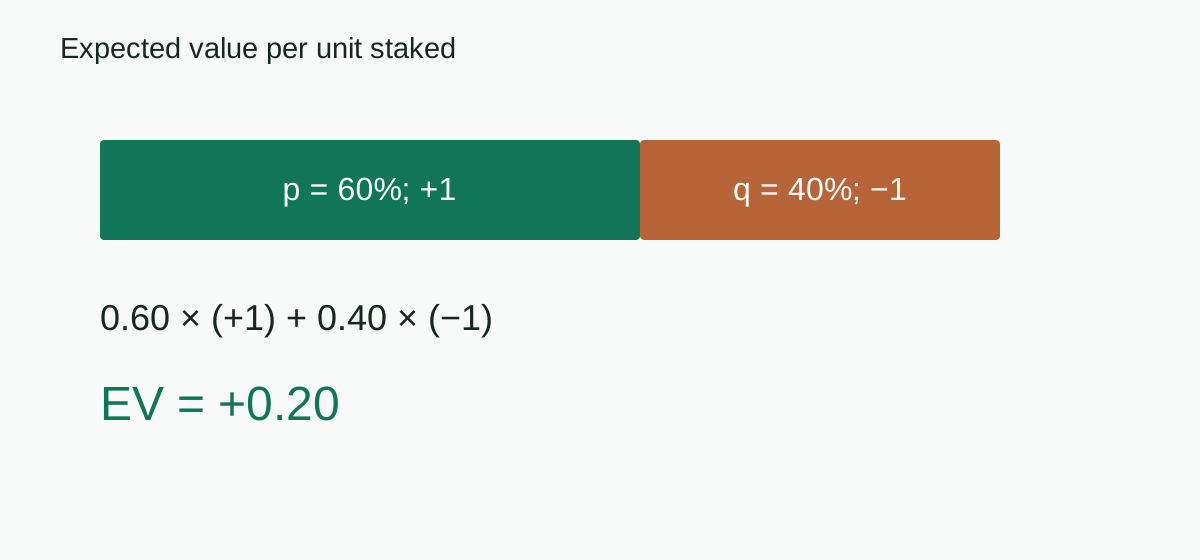
Having an edge does not mean you know with absolute certainty who will win the game. It means that if this exact sporting scenario were played out one thousand times under identical conditions, placing this bet at this specific price would generate a positive net return on investment. If your assessed true probability of an outcome is 55%, and the sportsbook's odds imply a 50% probability, you hold a 5% raw edge. Over time, that margin turns variance into consistent profit.
An edge is the gap between the true probability of an athletic event and the implied probability reflected in the bookmaker's price, minus the vig. If your probability estimate is mathematically sharper than the market's, the law of large numbers guarantees profitability over a substantial sample size.
The Two Distinct Paths: Top-Down vs. Bottom-Up Edge Finding
In modern sports analytics, profitable bettors hunt for advantages through two distinct methodologies:
1. The Top-Down (Market-Based) Approach: Building an accurate, complex predictive machine learning model from scratch is brutally difficult. Most solo bettors who attempt it fail within three months because sports data is noisy and full of non-linear variables. Instead, top-down bettors let the multi-million-dollar quant teams at market-making books do the heavy computational work. You treat the sharpest sportsbooks in the world (such as Pinnacle, Circa, or Betfair) as the definitive source of truth. You strip their lines of juice to find the "fair" consensus probability, and then you hunt for slower retail books that have lagged behind the move.
2. The Bottom-Up (Fundamental Modeling) Approach: Here, you build your own independent power ratings or statistical algorithms using foundational metrics like Expected Points Added (EPA) in football, adjusted net rating in basketball, or expected goals (xG) in soccer. You project your own fair spread, compare it to the board, and fire when your model detects a substantial discrepancy. This path requires serious programming and data discipline, but it can uncover edges in niche markets before any bookmaker notices.
Pinnacle and Circa as the Ultimate Truth Engines
If you are trying to find an edge without constantly benchmarking against Pinnacle and Circa, you are operating blindfolded. Pinnacle and Circa operate under a fundamentally different business model than recreational books: they accept high limits, they welcome winning action, and they never ban or limit profitable bettors. Instead of kicking sharps out, they use sharp bets to sharpen their numbers.
When professional syndicates blast a line at Pinnacle for $50,000, that line immediately adjusts to absorb the information. That adjusted price represents the most accurate probability estimate in existence. If Pinnacle shifts an NFL spread from -2.5 (-115) to -3.5 (-110), and you notice your local retail book is still sitting comfortably at -2.5 (-110), you don't need a PhD in statistics to realize you have found an overlay. You smash that stale number instantly.
Sharp tip: Set up real-time odds alert screens. When a market-making book moves a spread across a key number (like moving from -2.5 to -3.5 in the NFL), you typically have a 60-to-180-second window to hit the stale line at recreational books before their risk management feeds update.
Building Your Own Power Ratings: A Step-by-Step Blueprint
If you want to adopt the bottom-up approach, power ratings are your foundational building block. A power rating is simply a single numerical rating that reflects how many points a team is worth compared to an average baseline team on a neutral field:
# Basic NFL Power Rating Calculation:
Team A (Top Tier Contender): +6.0 points above average
Team B (Rebuilding Squad): -2.5 points below average
Baseline Neutral Field Difference: 6.0 - (-2.5) = 8.5 points in favor of Team A.

Apply Home-Field Advantage: Team B is hosting (+1.5 points for home field).
Projected Fair Spread = Team A -7.0 points.
Current Sportsbook Market Consensus = Team A -9.0 points.
Detected Edge: 2.0 full points of value backing Team B (+9.0).
When you have quantifiable power ratings updated weekly, you no longer rely on emotional narratives or commentator talking points. You simply compare your projected spread against the available market lines. If the difference exceeds your threshold of uncertainty (typically 1.5 to 2.0 points in high-scoring sports), you have an actionable play.
The Derivative & Micro-Market Goldmine
Main markets—such as the standard NFL point spread, Premier League 1X2 moneyline, or NBA total—are brutally efficient. Global betting syndicates trade millions of dollars on these markets, squeezing out almost every drop of value by kickoff.
If you want to find larger edges with less friction, look at derivative and secondary markets:
Player Props: Sportsbooks post hundreds of individual player propositions for every single game: points, rebounds, passing yards, player tackles. Bookmakers price these using automated templates with minimal manual oversight. If a starting running back is ruled out thirty minutes before game time, the backup's rushing prop is frequently mispriced for several minutes, creating massive 8% to 12% +EV opportunities.
First Half and First Quarter Lines: Many recreational books simply divide full-game lines in half (e.g., setting a first-half total as exactly half of the full-game total). This completely ignores sport-specific dynamics, such as teams that run conservative, run-heavy scripts in early quarters or basketball teams with slow-starting second units.
The Sharp Daily Edge-Finding Protocol
Finding edges consistently is an operational routine that requires systematic execution every single day:
- Opening Line Inspection: Check lines the minute they are released (openers). Sportsbooks set conservative limits on openers because their initial numbers are soft. This is when the purest model-versus-bookmaker edges appear.
- No-Vig Fair Odds Conversion: Strip the vigorish from the sharpest available benchmark books to determine the true consensus probability. Learn the mechanics in SportsBettingMath's expected value guide.
- Line Shopping Across Multiple Books: Compare that fair probability across all of your active funded sportsbook accounts. Identify where the biggest positive discrepancy exists.
- Disciplined Staking: Never alter your stake size based on excitement or "feeling good" about a pick. Size your bet using strict flat units (1% of bankroll) or a conservative fractional Kelly approach.
- Closing Line Value Validation: Record the closing line for every bet you place in an ongoing tracking log. If you beat the closing number on at least 65% of your wagers, your edge is real.
Separating True Edge from Statistical Noise
The biggest psychological pitfall in sports betting is confusing a short-term winning streak with having a genuine edge. A bettor can place 50 completely unresearched, negative-EV bets on random favorites and win 35 of them purely through lucky variance. Conversely, a sharp bettor with a verified 4% edge can endure a brutal 15-bet losing streak over a ten-day slump.
Do not judge your process by whether a bet wins or loses on any given night. Judge your process by the price you paid relative to the closing market price. If you consistently bought +140 on teams that closed at +120, you have an edge, regardless of what the final scoreboard says. Trust the mathematics, preserve your capital, and let the edge compound over thousands of bets.