
Market Formation: How the Sausage is Made
Look, sportsbooks aren't in the prediction business. They're in the risk management and fee-collection business. They don't set an opening line trying to forecast the future with crystal-ball precision; they set an initial price to test the market, gauge public sentiment, and balance their liability across competing positions. In the opening hours, they're essentially guessing just like any other bettor with a spreadsheet. Then the smart money enters the arena.
Pinnacle and Circa—the sharpest market-making sportsbooks on the planet—post their opening numbers with low betting limits. When professional betting syndicates and high-stakes quant groups blast an opener for maximum allowable limits, the bookmaker absorbs that information instantly. If three separate syndicates hammer Team A at -2.5 within ninety seconds, Pinnacle immediately moves the line to -3.5. They don't take it personally; they simply allow the capital to reshape the pricing.
Here is the critical detail recreational bettors miss: roughly 90% of retail sportsbooks (the shiny apps you see advertised during prime-time sports broadcasts) do not generate their own independent lines. They purchase syndicated live odds feeds and copy the market makers with a slight time delay and an inflated vigorish margin. That delay between originators and copycats is the playground where disciplined line shoppers generate their entire annual income.
Why the Closing Line is Everything
We need to talk about Closing Line Value (CLV). The closing line—the final odds recorded seconds before the referee blows the whistle—is the single most efficient price point available in modern financial markets. Thousands of informed bets, insider injury updates, weather data, and millions of dollars have battered that market into an equilibrium of ruthless efficiency.
If you consistently place wagers on a team at +150 on Thursday, and by Sunday kickoff the consensus market has hammered that team down to +130, you possess a massive, quantifiable mathematical edge. Beating the closing line consistently across a sample of 500 or 1,000 bets equals guaranteed long-term profitability. Full stop.
Variance will always dictate whether your individual bets win or lose on a Tuesday night. A bad bounce, a missed penalty, or a blown referee call can sink a brilliant ticket. But variance is powerless against a bettor who consistently captures 15 to 20 cents of positive CLV over an entire season. The math inevitably asserts its dominance.
CLV isn't an academic theory; it is the exact metric sportsbooks use to profile your account. If you consistently beat their closing numbers by even 2% to 3%, their risk-management algorithms flag you as sharp. Recreational books don't ban bettors who get lucky on 10-leg parlays; they restrict players who consistently buy stale, off-market prices before the closer.
The Cost of Being Lazy: The Multi-Account Reality
Imagine walking into a supermarket where a gallon of milk costs $5.00. The store directly across the street sells the exact same milk for $3.50. You wouldn't pay $5.00 out of brand loyalty, would you? Yet millions of sports bettors log into a single sportsbook app every single weekend and casually accept whatever price is listed on their screen.
Having active, funded balances at 4 to 6 sportsbooks is the bare minimum requirement to play this game seriously. Taking whatever line your preferred app offers is financial suicide. If you give up just 5 to 10 cents on every wager because you refused to check two alternative apps, you are surrendering your entire statistical edge to the bookmaker's margin.
To understand how this directly impacts the math, you should study SportsBettingMath's EV analysis. A bet that is +EV at +105 becomes instantly -EV and wealth-destroying at -110.
Steam, RLM, and Sharp Signal Detection
Market movements leave distinct footprints. If you understand how to decode them, you can ride the coattails of the most sophisticated gambling syndicates in the world:
Steam Moves: Steam refers to sudden, violent line movement occurring across multiple sportsbooks within a 60-second window. This happens when a major betting syndicate hits their target number across dozens of books simultaneously. The originators move first, followed by copycat books scrambling to adjust their liability.
Reverse Line Movement (RLM): This occurs when the betting line moves directly opposite to the public betting percentages. For example, if public tracking data indicates that 82% of all ticket slips are backing the Kansas City Chiefs at -7, yet the line drops to -6 or -5.5, that is classic RLM. The retail public is pouring recreational $25 bets on the favorite, but professional syndicates are unloading six-figure wagers on the underdog. In sharp betting, you follow the money, not the crowd.
Sharp tip: Never chase stale steam blindly. If you see an NBA line crash from -3 to -5, the value was entirely at -3 and -3.5. If you bet the team at -5 after the move has completed, you are paying retail price for secondhand goods and handing the advantage right back to the book.
The Power of Key Numbers: Why the Half-Point is Gold
In point-spread sports, not all half-points are created equal. The distribution of final scoring margins is heavily clustered around specific key numbers due to the structural scoring rules of each game.
In the NFL, roughly 15% of all games end with a final margin of exactly 3 points, and approximately 9% end with a margin of 7 points. That means moving from +2.5 to +3.5 is worth significantly more than moving from +8.5 to +9.5. Grabbing a team at +3.5 when another book offers +3.0 completely transforms a push into a cash win whenever that 3-point margin lands.
In basketball, numbers like 4, 5, and 7 represent common terminal foul margins. In soccer, securing an Asian handicap of +0.25 versus +0.0 (Draw No Bet) protects half your stake in a draw. Line shopping allows you to systematically cherry-pick key numbers without paying exorbitant alternative spread penalties.
Death by a Thousand Cuts: The Mathematical Impact of Vig
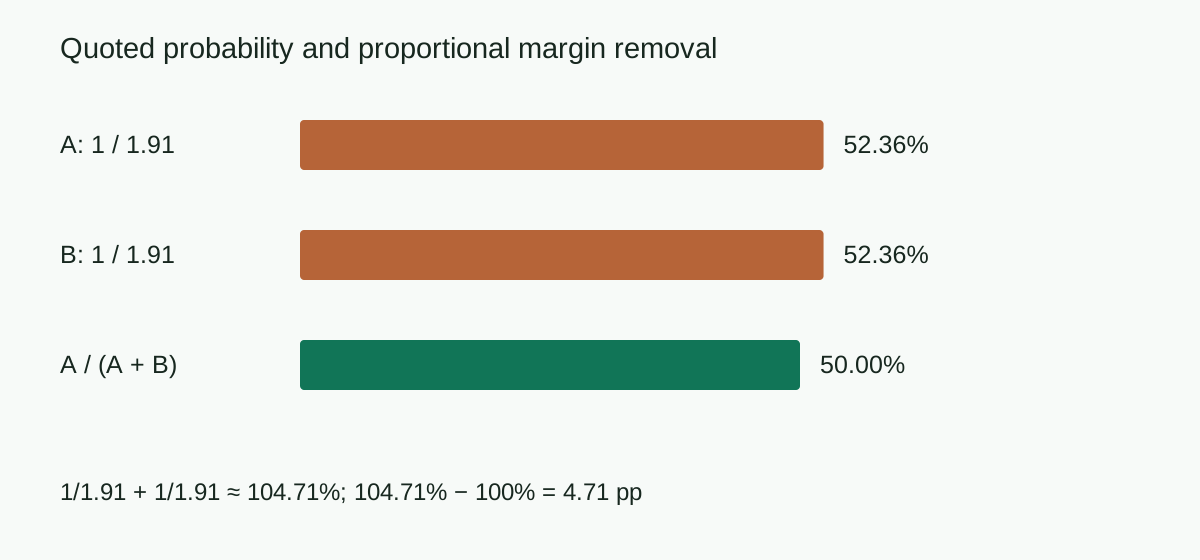
The vigorish (juice) is the silent assassin of the sports betting bankroll. When a bookmaker quotes -110 on both sides of a coin flip, they demand you risk $110 to win $100. That implies a break-even win rate of 52.38%. If you shop around and find a reduced-juice book offering -105, your break-even threshold drops to 51.22%.
The Long-Term Impact of a 5-Cent Line Difference:
Sample: 1,000 bets of $100 risk per game at a 53% win rate (530 wins, 470 losses).
Case A (-110 standard juice):
Profit = (530 * $90.91) - (470 * $100) = $48,182 - $47,000 = +$1,182.
Case B (-105 reduced juice or shopped price):
Profit = (530 * $95.24) - (470 * $100) = $50,477 - $47,000 = +$3,477.
Net Difference: +$2,295 in pure profit on the exact same sporting outcomes!
You didn't need to pick more winners. You didn't need to become an expert on college football bench rotations. You simply shopped for the best available price on the screen. For a comprehensive theoretical breakdown of bookmaker margins, review SportsBettingMath's margin analysis guide.
The Sharp Daily Line-Shopping Workflow
Professional line shopping is a daily operational discipline. It requires establishing a rigid morning-to-night routine rather than placing casual wagers on impulse:
- Morning Market Scan: Open an odds comparison grid (such as an odds screen or multiple desktop tabs) 3 to 4 hours before the game. Identify any retail book lagging behind market-making benchmarks like Pinnacle.
- Discrepancy Pinpointing: Look for consensus lines that have moved while a slower regional sportsbook has left their old odds hanging. An unadjusted +120 when the rest of the world sits at +105 represents immediate +EV.
- Split-Second Execution: Place the wager immediately without hesitation. Slow books eventually catch up; that stale number will often vanish within 90 seconds.
- Strict Bankroll Isolation: Maintain working capital in at least 4 active books so you never miss an off-market line because your funds were tied up in a pending withdrawal.
- Log Your CLV: Record the odds you obtained alongside the eventual closing price. If your process is sound, your spreadsheet will show steady green CLV week after week.
Line shopping is the easiest edge in sports betting because it requires zero predictive clairvoyance. It simply asks you to respect your money and refuse to pay retail prices.