When evaluating NFL matchups, many bettors focus solely on player matchups, injury reports, and recent form, neglecting one of the most significant external variables: the weather. Because the NFL season spans from September to January and features games in diverse climates across outdoor stadiums, weather conditions play a fundamental role in shaping game flow, scoring output, and overall efficiency. If you are betting totals or spreads without consulting the forecast, you are likely leaving value on the table.
Why Weather Matters in the NFL
Unlike indoor sports, football is heavily exposed to the elements. Weather impacts everything from the trajectory of a deep pass to the footing of a running back and the range of a field goal kicker. As the season progresses into late autumn and winter, conditions worsen in cities like Buffalo, Green Bay, and Chicago. This environmental variance forces teams to adjust their game plans, often shifting away from complex passing attacks toward ground-heavy, clock-chewing strategies.
For sports bettors, these forced strategic shifts are where the value lies. The betting market anticipates standard conditions when opening lines, and while oddsmakers adjust for severe weather, they frequently fail to capture the full extent of the impact, especially when forecasts change rapidly in the hours leading up to kickoff.
Wind: The Sharpest Weather Edge
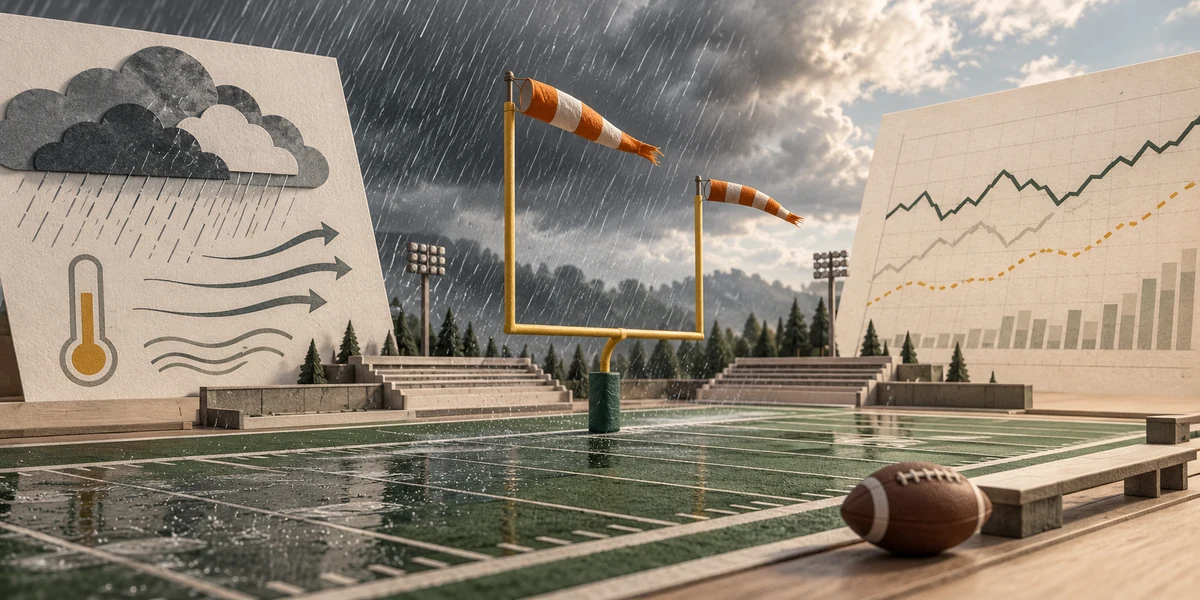
Of all weather elements, wind is the most disruptive to NFL offenses and the most profitable for observant bettors. While rain and snow look dramatic on television, high winds fundamentally alter the mechanics of the game. When sustained winds exceed 15 mph, passing efficiency drops noticeably. Deep routes become unreliable, and quarterbacks are forced to rely on short, high-percentage throws that yield fewer explosive plays.
The 15 MPH Threshold: Statistical models indicate that wind speeds below 10 mph have negligible effects on scoring. The threshold for significant impact begins at 15 mph, with effects compounding sharply as wind speeds cross 20 mph. At this point, kicking accuracy drops severely, and passing attacks become largely ineffective beyond 15 yards.
Furthermore, special teams suffer immensely. Field goals and punts are heavily affected by crosswinds, leading to missed kicks, shorter punts, and better starting field position for the opposition. Understanding these mechanics is crucial for finding edges in total markets, as the combined reduction in passing efficiency and kicking reliability creates strong downward pressure on scoring.
WEATHER IMPACT ON NFL TOTALS (2015-2025)
Wind 15-20 mph:  Avg total 41.2 (vs 45.8 normal) → -4.6 pts
Wind 20+ mph:    Avg total 38.7 (vs 45.8 normal) → -7.1 pts
Rain (moderate): Avg total 42.1 (vs 45.8 normal) → -3.7 pts
Snow:            Avg total 40.5 (vs 45.8 normal) → -5.3 pts
Temp < 32°F:     Avg total 39.8 (vs 45.8 normal) → -6.0 pts
Rain and Snow: Aesthetics vs. Reality
While wind disrupts the flight of the ball, precipitation disrupts the grip and the footing. Rain makes the ball slick, increasing the likelihood of fumbles and dropped passes. Snow can have a similar effect, though light snow sometimes has less impact than heavy, freezing rain. The primary consequence of heavy precipitation is a shift in game script; offensive coordinators will call more running plays to minimize the risk of turnovers through the air.
This run-heavy approach keeps the game clock moving, reducing the total number of possessions for each team. Fewer possessions naturally correlate with lower scoring. When betting into these situations, consider how the specific precipitation affects both the offenses and the defenses. A slick field can sometimes benefit offensive players who know their routes, while defensive backs struggle to react without losing their footing.
Sharp tip: Do not just bet the under blindly when you see precipitation. Evaluate the rushing defenses of both teams. If one team has an elite rushing attack and the other has a porous run defense, the favorite might dominate time of possession and still score efficiently.
Cold Weather and The Dome Disadvantage
Extreme cold (sub-32°F) introduces another layer of inefficiency. The football becomes hard, making it difficult to grip, throw, and catch. Tackling becomes more punishing. Scoring traditionally dips in freezing temperatures, not just because of the cold itself, but because extreme cold is often accompanied by wind or frozen fields.
One of the most reliable betting angles involves dome teams traveling to cold, outdoor venues late in the season. Teams that play their home games in climate-controlled environments often struggle to adapt to freezing conditions. Their fast-paced, pass-heavy offenses, built for turf and perfect weather, tend to stall on frozen grass. Conversely, cold-weather teams traveling to domes do not experience a reciprocal disadvantage; they often enjoy the improved playing conditions.
Using Weather in Totals Betting
The most direct application of weather analysis is in betting totals (over/under). Oddsmakers incorporate preliminary forecasts into their opening lines, but the weather can change significantly throughout the week. If an unexpected front moves in, bringing high winds, the total will crash. Bettors who monitor meteorological data can secure favorable numbers before the market fully adjusts.
Additionally, weather creates opportunities for live betting. If a forecast calls for heavy rain in the second half, the pre-game total might account for it, but if the rain is delayed, the first half might feature higher-than-expected scoring. For a more rigorous approach to these pricing discrepancies, understanding the margin index can help you quantify the exact mathematical expectation.
Weather Data Sources and Timing
A common mistake novice bettors make is reacting to weather forecasts on Tuesday for a Sunday game. Weather patterns are volatile. A predicted blizzard can easily shift slightly and miss the stadium entirely. The sharp approach is to monitor the forecast throughout the week but wait until 2-4 hours before kickoff to make final decisions on weather-dependent bets.
Use reliable, hyper-local sources rather than generic national forecasts. Stadiums often have specific microclimates; for example, the design of a stadium might shield the field from prevailing winds or create a wind tunnel effect. Knowing the exact orientation and architecture of the venue is just as crucial as knowing the general forecast.